


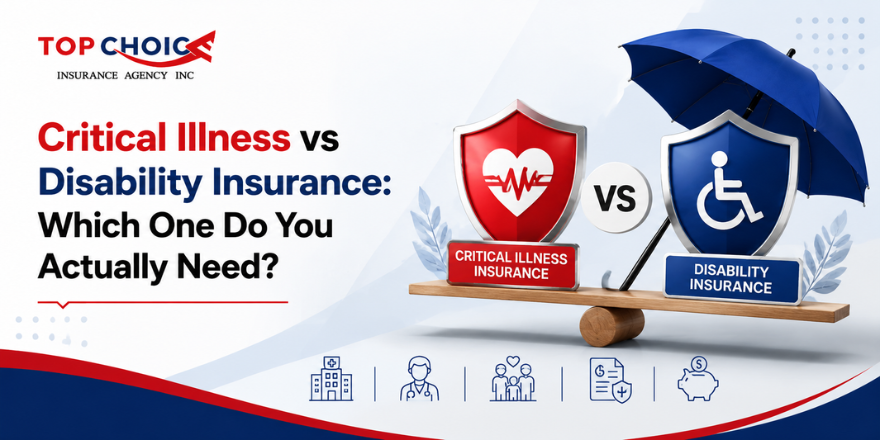
When life takes an unexpected turn — a cancer diagnosis, a heart attack, or an accident that leaves you unable to work — the financial fallout can be just as devastating as the health crisis itself. That is where critical illness insurance and disability insurance come in. Both are designed to protect your finances when you can’t protect them yourself, but they work in very different ways.
If you are a Canadian resident trying to decide between the two, you are not alone. Many people in Brampton, Mississauga, and across Ontario find these two products confusing — and end up with either the wrong coverage or no coverage at all.
What Is Critical Illness Insurance?
Critical illness insurance pays you a one-time, tax-free lump sum if you are diagnosed with a covered serious medical condition. The payout is yours to use however you choose — whether that means covering medical bills, paying your mortgage, hiring a caregiver, or simply taking time off work to focus on recovery.
In Canada, most critical illness policies cover a core list of conditions including:
- Cancer (life-threatening)
- Heart attack
- Stroke
- Coronary artery bypass surgery
- Major organ transplant
- Kidney failure
- Multiple sclerosis
- Alzheimer’s disease
- Paralysis
Some comprehensive plans cover up to 25 or more conditions. Payouts typically range from $25,000 to $1,000,000 depending on the policy you choose. The key thing to understand is that critical illness insurance pays out based on diagnosis, not on whether you can work.
Who Is Critical Illness Insurance Best For?
Critical illness coverage is ideal if you want a financial cushion that gives you flexibility during a serious health event. It works especially well for:
- Self-employed individuals without employer health benefits
- Business owners who need funds to keep operations running during illness
What Is Disability Insurance?
Disability insurance, on the other hand, replaces a portion of your monthly income if an illness or injury prevents you from working. Rather than a one-time payment, it pays out a regular monthly benefit — typically 60% to 85% of your pre-disability income — for as long as you remain unable to work, up to the benefit period specified in your policy.
There are two main types:
- Short-term disability insurance: Covers temporary disabilities, usually for 3 to 6 months.
- Long-term disability insurance: Kicks in after short-term coverage ends and can pay out for years — or even until retirement age.
Disability insurance covers a much broader range of conditions than critical illness. You don’t need to be diagnosed with a specific illness to qualify. If a back injury, chronic pain condition, or mental health disorder keeps you off work, disability insurance can step in.
Read more : How Disability Insurance Protects Your Financial Future
Who Is Disability Insurance Best For?
Disability insurance is essential for anyone whose income is the foundation of their family’s financial security. It is particularly important for:
- Employees who depend on monthly income to cover rent, mortgage, and bills
- Professionals in physically demanding trades or occupations
- Individuals without a significant emergency fund
- Anyone whose employer’s group disability coverage is limited or non-existent
Critical Illness vs Disability Insurance: The Core Differences
| Feature | Critical Illness Insurance | Disability Insurance |
| Payout type | One-time lump sum | Monthly income replacement |
| Trigger | Specific diagnosis | Inability to work |
| Conditions covered | Listed critical illnesses | Any illness or injury |
| How funds are used | Your choice, no restrictions | Replaces lost income |
| Duration of benefit | Single payment | Months to years |
| Best for | Flexibility during recovery | Ongoing income protection |
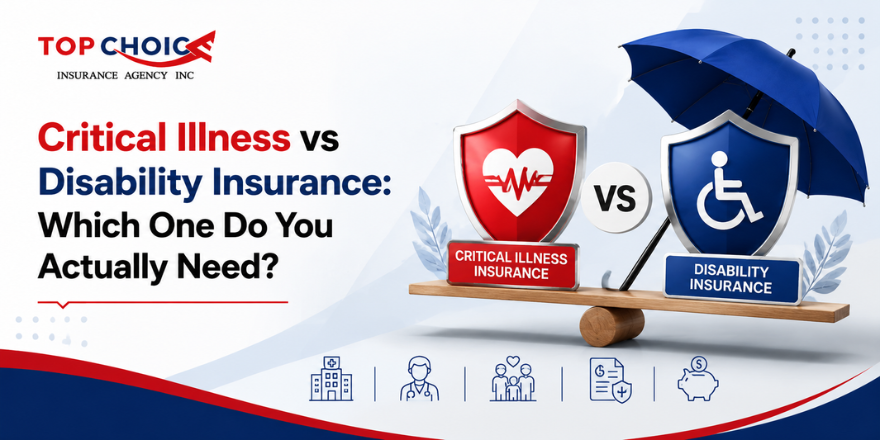
The most important distinction is this: critical illness insurance pays when you get sick; disability insurance pays when you can’t work. A person can be diagnosed with a covered critical illness and still continue working — in which case disability insurance may not pay out, but critical illness insurance would. Conversely, a back injury or severe depression can prevent you from working without triggering a critical illness benefit.
Do You Need Both?
Ideally, yes — and here is why. These two products protect different aspects of your financial life and complement each other rather than overlap.
Think of it this way: if you suffer a stroke and can no longer work, disability insurance covers your monthly mortgage and living expenses. The lump sum from your critical illness policy, meanwhile, can pay for specialized rehabilitation, out-of-country treatment, modifications to your home, or simply give your spouse the ability to reduce their work hours and care for you.
Together, they form a complete financial safety net. However, if budget is a concern and you must choose one, consider your personal situation carefully. If your primary concern is replacing your income month-to-month, disability insurance is the higher priority. If you have income protection through an employer plan but want a financial buffer for unexpected treatment costs, critical illness insurance fills that gap.
A Word on Coverage Gaps in Canada
Many Canadians assume they are fully covered through government healthcare or employer group benefits. The reality is different. Provincial health plans cover basic hospital and physician services, but they do not cover lost income, private nursing, experimental treatments, or home modifications after a serious illness. Group disability plans through employers often cap benefits at modest levels and may exclude mental health conditions or pre-existing illnesses.
This is exactly why working with an experienced, independent insurance broker in Brampton matters. At Top Choice Insurance, our advisors take the time to assess your existing coverage, identify gaps, and recommend the right combination of products from Canada’s top insurers — without pushing products that don’t serve your actual needs.
Ready to Protect What Matters Most?
Choosing between critical illness and disability insurance does not have to be complicated. The right answer depends on your income, health history, existing coverage, and financial goals — and a 15-minute conversation with a licensed broker can bring complete clarity.
Contact Top Choice Insurance in Brampton today for a no-obligation consultation and personalized quote.
Frequently Asked Questions (FAQs)
Can I have both critical illness and disability insurance at the same time?
Yes, absolutely. In fact, carrying both policies provides the most comprehensive financial protection. They cover different scenarios and pay out independently of each other. Many Canadians — especially self-employed individuals and business owners — benefit from holding both types of coverage simultaneously.
Does critical illness insurance pay out if I survive the illness?
Yes. In Canada, most critical illness insurance policies require you to survive a waiting period (typically 30 days after diagnosis) before the lump sum is paid. As long as you meet this condition and your diagnosis qualifies under the policy terms, you receive the full benefit regardless of your recovery status.
What illnesses are covered under critical illness insurance in Canada?
Most Canadian policies cover a standard list that includes cancer, heart attack, stroke, organ transplant, kidney failure, multiple sclerosis, Alzheimer’s disease, Parkinson’s disease, and blindness. Premium policies can cover 25 or more conditions. Always review the full list of covered conditions before purchasing a policy.
How much disability insurance do I need in Canada?
A general rule of thumb is to have coverage equal to approximately 60–85% of your gross monthly income. However, the ideal amount depends on your monthly expenses, existing savings, any employer group benefits you carry, and whether you are self-employed. A licensed broker can help calculate the right coverage level for your situation.
Is disability insurance tax-deductible in Canada?
It depends on who pays the premium. If you pay your disability insurance premiums personally, the benefit is received tax-free. If your employer pays the premiums, the benefit is considered taxable income when received. For self-employed individuals who pay their own premiums, benefits are generally tax-free — a significant advantage worth factoring into your planning.

We want to be your insurance broker. We provide personal, high-quality service and offer policies in all areas of insurance – Critical, Disability, Health and Dental, Travel and domestic requirements using only authorized Canadian-based insurers.